Skip Navigation


Emergency Communications Dispatcher

Help protect Escambia County by answering emergency calls, coordinating first responders and providing critical information during emergencies and disasters.

Interested in Joining the Team?

Visit Escambia County Human Resources to search current job opportunities and learn how to apply.

View Employment Opportunities

Position Overview

One position serving three distinct emergency communication disciplines.

This classification incorporates three separate disciplines under one job title: Fire Dispatch, EMS Dispatch and Primary 911 Call Taking.

Dispatchers coordinate Escambia County Fire Rescue and Escambia County EMS responses throughout an area covering more than 600 square miles. The position provides emergency dispatch services to 21 fire jurisdictions and up to 15 ambulance units located throughout the county and mutual aid areas.

Dispatchers also answer and process 911 calls originating within Escambia County and assist Emergency Management by serving as the 24-hour County Warning Point during natural disasters, escalating incidents and other emergencies.

600+ Square miles served
21 Fire jurisdictions
15 Ambulance units
24/7 County Warning Point
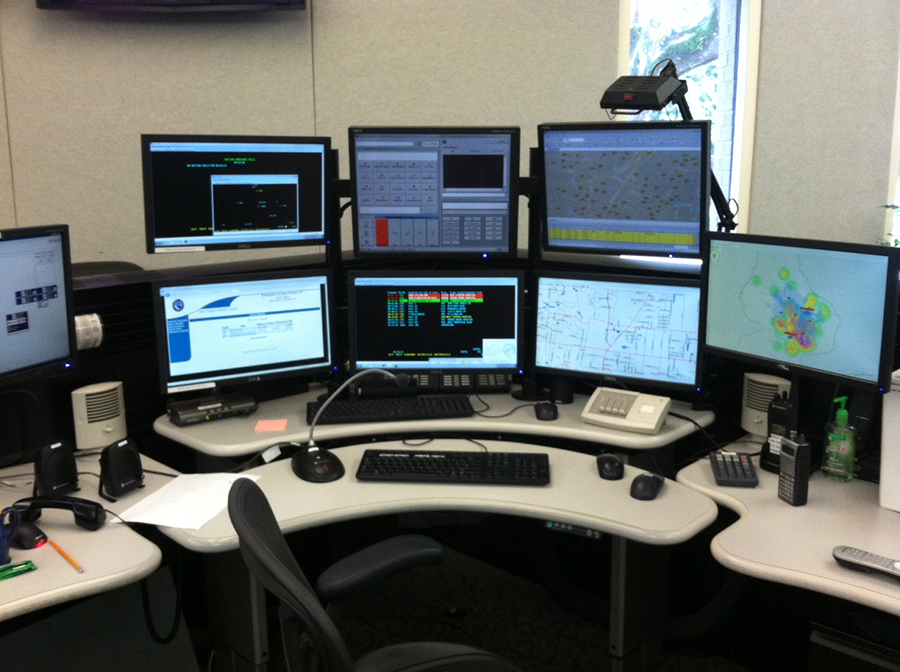
Emergency Communications Console
Escambia County Emergency Communications dispatch console

Examples of Duties

Select a duty area to review its responsibilities.

Fire Dispatch

Dispatch appropriate Escambia County Fire Rescue apparatus to residential fires, commercial fire-related incidents, wildland fires and serious medical calls while maintaining continuous contact with responding units.

Additional responsibilities include:

  • Updating responders with current and changing scene information.
  • Announcing hydrant locations.
  • Tracking unit status changes in Computer Aided Dispatch.
  • Initiating procedures for escalating events.
  • Notifying ECFR staff during major incidents.
  • Monitoring approximately 50 County building fire-alarm accounts.
EMS Dispatch

Dispatch appropriate EMS units to medical emergencies and maintain constant radio contact with responders while providing current patient and scene information.

  • Select the closest or most appropriate unit for each emergency.
  • Track unit status changes and update patient information in CAD.
  • Monitor projected call locations to ensure adequate unit coverage.
  • Coordinate mutual aid requests, including requests to launch Life Flight.
  • Coordinate critical patient information with area hospitals.
Emergency Call Taking

Answer emergency calls, verify the caller’s location and callback number, and determine the nature of each emergency. Crime-related calls are transferred to the appropriate law enforcement agency.

Medical Calls

Process medical calls using nationally recognized protocols. Assign the correct call type and priority based on the caller’s responses to scripted questions and enter all information into CAD.

Dispatchers may provide:

  • CPR instructions.
  • Childbirth instructions.
  • Heimlich maneuver instructions.
  • Bleeding-control measures.
  • Airway-maintenance instructions.
  • Scene-safety instructions.

Dispatchers also coordinate information about trauma, cardiac arrest, gunshot or stabbing victims, and burn patients with area hospitals.

Fire Calls

Process fire calls using nationally recognized protocols, assign the appropriate call type and priority, and enter caller responses into CAD.

Dispatchers provide scene-safety instructions, coordinate incidents with the State Fire Marshal’s Office and State Watch Office when appropriate, and notify ECFR staff of escalating events.

Non-Emergency and Administrative Duties

Process non-emergency transfer requests by comparing and verifying the patient’s condition against emergency criteria. Administrative requests are processed as appropriate.

The position also coordinates road closures, flooding conditions and disaster incidents with Emergency Management and state officials.

Administrative duties include monitoring equipment status, entering data into dispatch systems and transmitting documentation.

Typical Qualifications

Education, experience and certification requirements.

Education and Experience

  • High school diploma or equivalent GED.
  • Up to one year of experience as an emergency dispatcher, EMT, paramedic, firefighter, police officer or air traffic controller.
  • An equivalent combination of education and experience may also be considered.
  • Ability to keyboard at the prescribed rate of speed.

Licenses and Certifications

  • State of Florida Department of Health Telecommunicator License.
  • National Academy of Emergency Medical Dispatch Certification.
  • National Academy of Emergency Fire Dispatch Certification.
  • American Heart Association CPR Health Care Provider Certification.
  • National Incident Management System IS-100 and IS-700.

Knowledge and Skills

Core capabilities needed for emergency communications.

Knowledge

  • Escambia County geography.
  • Customer service principles.

Skills

  • Computer entry and common software applications.
  • Operating multi-channel radios.
  • Remaining calm in stressful and emotional situations.
  • Map reading.
  • Multitasking.
  • Interpersonal communication with coworkers, supervisors and the public.
  • Clear and concise speech.

ADA Requirements

Physical and work requirements associated with the position.

Physical Requirements

Positions in this class typically require reaching, standing, walking, fingering, grasping, talking, hearing, seeing and repetitive motions.

Light Work

Exerting up to 20 pounds of force occasionally, up to 10 pounds frequently, or a negligible amount of force constantly to move objects.

If operating arm or leg controls requires greater force than sedentary work while the employee remains seated most of the time, the position is classified as light work.

Helpful Links

Employment and telecommunicator training resources.

Escambia County logo

The mission of Escambia County government is to provide efficient, responsive services that enhance our quality of life, meet common needs and promote a safe and healthy community.

Under Florida law, IP addresses and both the content of emails and email addresses are public records. If you do not want your IP address, the content of your email, or your email address released in response to a public records request, do not send electronic mail to this entity. Instead, contact this office by phone or in person.

All content © 2026 Escambia County, FL and its representatives. All rights reserved.