


Living Shorelines Support Resilient Communities
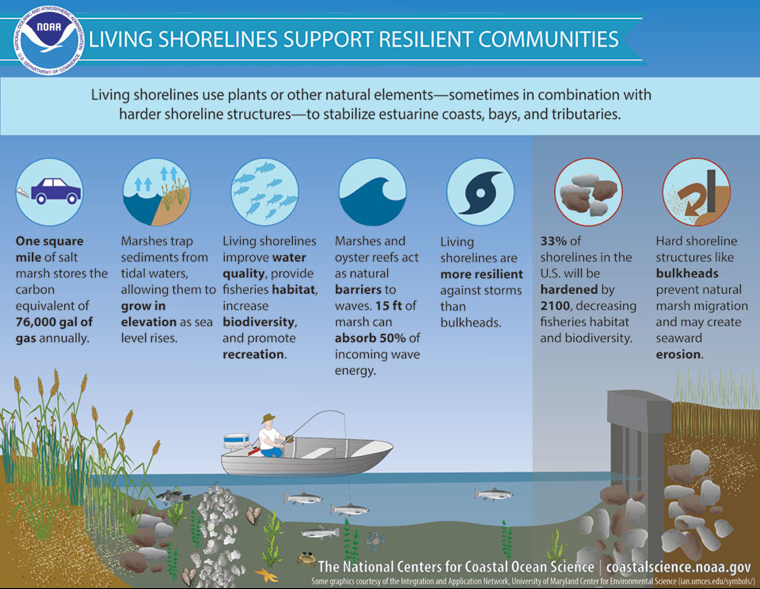
Living shorelines use plants or other natural elements—sometimes in combination with harder shoreline structures—to stabilize estuarine coasts, bays, and tributaries.
- One square mile of salt marsh stores the carbon equivalent of 76,000 gallons of gas annually.
- Marshes trap sediments from tidal waters, allowing them to grow in elevation as sea level rises.
- Living shorelines improve water quality, provide fisheries habitat, increase biodiversity, and promote recreation.
- Marshes and oyster reefs act as natural barriers to waves. 15 feet of marsh can absorb 50% of incoming wave energy.
- Living shorelines are more resilient against storms than bulkheads.
- 33% of shorelines in the U.S. will be hardened by 2100, decreasing fisheries habitat and biodiversity.
- Hard shoreline structures like bulkheads prevent natural marsh migration and may create seaward erosion.
Source: The National Centers for Coastal Ocean Science
coastalscience.noaa.gov
