Skip Navigation


Rip currents are the greatest danger to beach patrons and account for more than 80 percent of water rescues performed by surf rescue lifeguards. Rip currents cause more deaths each year than shark attacks do each decade. The best defense against drowning is knowing how to swim. Swimming in a pool is NOT the same as swimming at a surf beach with crashing waves, winds and dangerous currents. The conditions in the Gulf can change very quickly, and you should be a strong swimmer before entering the water.

What is a Rip Current?

Rip currents are powerful channels of water that are caused by breaks in the sandbar just offshore. Currents flowing away from the coast move fastest where the sandbar is reduced or not present and the water is deeper. Always swim near a lifeguard and ask them where it is safest to swim. If lifeguards are not present, attempt to stay on the sandbars and avoid the area between sandbars where the water color is typically darker. Avoid swimming near piers and jetties where permanent rip currents are present.

How to Escape

If you become caught in a rip current, escape by swimming sideways to the direction the current is pulling you, or parallel to shore. If you cannot swim out of the rip or the current is too strong, go with the flow offshore and the rip current will weaken. Then, swim back to shore at an angle away from the rip current.

To learn more about rip currents, visit the National Weather Service's Rip Current Safety Website.

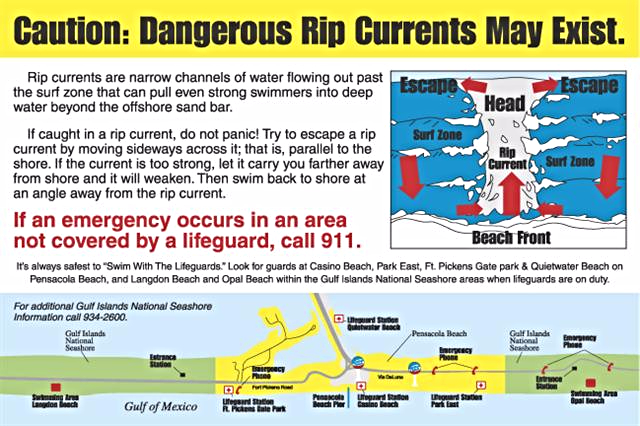
Rip current safety information including how to escape a rip current and when to call 911.
Readable text from this image

Caution: Dangerous Rip Currents May Exist

Rip currents are narrow channels of water flowing out past the surf zone that can pull even strong swimmers into deep water beyond the offshore sand bar.

If caught in a rip current:

  • Do not panic
  • Swim parallel to the shore to escape the current
  • If the current is too strong, float or tread water
  • Once free, swim back to shore at an angle away from the current

If an emergency occurs in an area not covered by a lifeguard, call 911.

Safety Reminder

Always swim near lifeguards. Look for guards at Casino Beach, Park East, Ft. Pickens Gate Park, and Quietwater Beach on Pensacola Beach, and Langdon Beach and Opal Beach within the Gulf Islands National Seashore when lifeguards are on duty.

Additional Information

For additional Gulf Islands National Seashore information, call 434-264-2600.
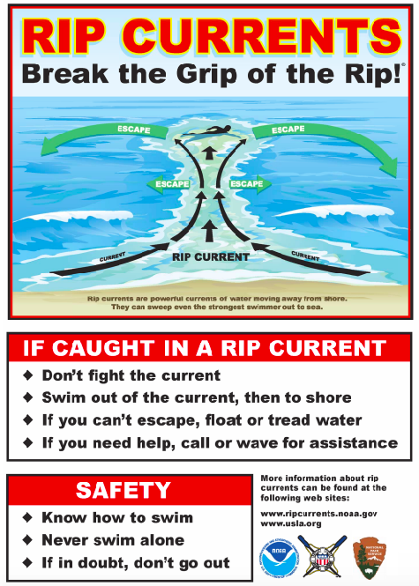
Rip current safety information explaining how to escape and what to do if caught in a rip current.
Readable text from this image

Rip Currents: Break the Grip of the Rip

Rip currents are powerful channels of water moving away from shore. They can sweep even strong swimmers out to sea.

If Caught in a Rip Current:

  • Don’t fight the current
  • Swim out of the current, then toward shore
  • If you can’t escape, float or tread water
  • If you need help, call or wave for assistance

Safety Tips:

  • Know how to swim
  • Never swim alone
  • If in doubt, don’t go out

For more information about rip currents, visit:
www.ripcurrents.noaa.gov
www.usla.org

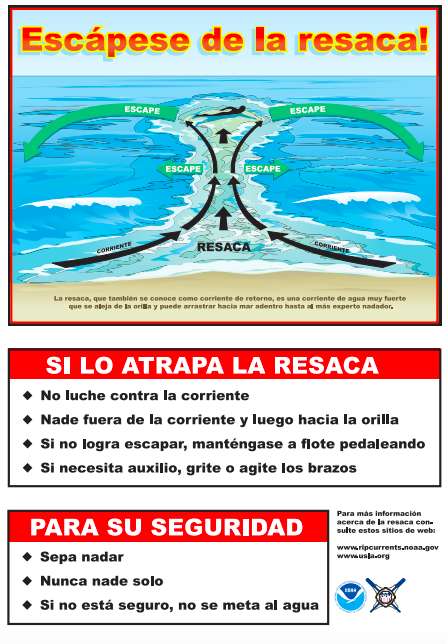
Información en español sobre corrientes de resaca y cómo escapar de forma segura.
Texto legible de esta imagen

¡Escápese de la resaca!

La resaca, también conocida como corriente de retorno, es una corriente de agua muy fuerte que se aleja de la orilla y puede arrastrar mar adentro incluso al nadador más experimentado.

Si lo atrapa la resaca:

  • No luche contra la corriente
  • Nade fuera de la corriente y luego hacia la orilla
  • Si no logra escapar, manténgase a flote pedaleando
  • Si necesita auxilio, grite o agite los brazos

Para su seguridad:

  • Sepa nadar
  • Nunca nade solo
  • Si no está seguro, no se meta al agua

Para más información sobre corrientes de resaca, visite:
www.ripcurrents.noaa.gov
www.usla.org

Escambia County logo

The mission of Escambia County government is to provide efficient, responsive services that enhance our quality of life, meet common needs and promote a safe and healthy community.

Under Florida law, IP addresses and both the content of emails and email addresses are public records. If you do not want your IP address, the content of your email, or your email address released in response to a public records request, do not send electronic mail to this entity. Instead, contact this office by phone or in person.

All content © 2026 Escambia County, FL and its representatives. All rights reserved.