
Skip Navigation


Mitigation is taking action to prevent or reduce effects of emergencies or disasters before they occur.  By taking action now, residents, governments and businesses can decrease property damage and save lives. There are several grant programs offered by both FEMA and the State of Florida including hazard mitigation pre-disaster flood, repetitive flood claims, severe repetitive loss and residential construction mitigation programs. These programs help to rebuild lives and communities that have been impacted by a major disaster, and to reduce the impact of future disasters through mitigation. Find more information from the following sources: 

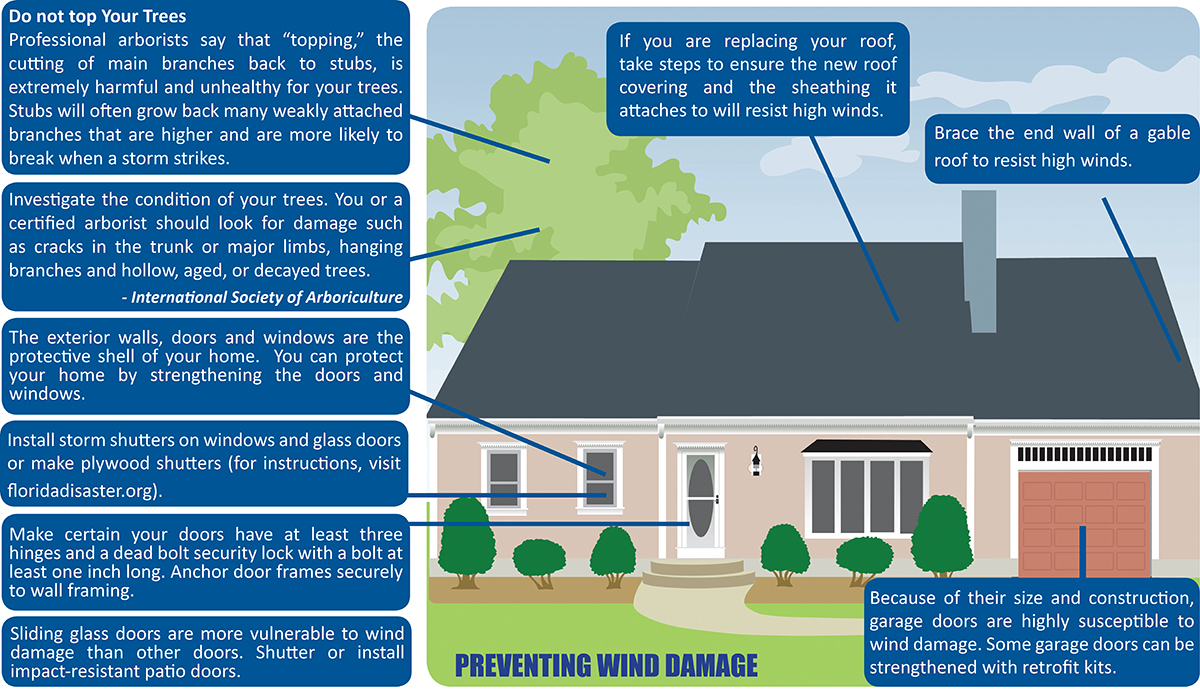
Home wind mitigation infographic showing ways to prevent wind damage to trees, roofs, windows, doors, and garage doors.
Readable text from this image

Preventing Wind Damage

Trees

  • Do not top your trees. Cutting main branches back to stubs is harmful and can lead to weak regrowth that is more likely to break during storms.
  • Inspect trees regularly or have a certified arborist check for damage such as cracks, hanging branches, or decay.

Roof

  • If replacing your roof, ensure the covering and attachments are properly secured to withstand high winds.
  • Brace the end wall of a gable roof to improve wind resistance.

Walls, Doors, and Windows

  • Strengthen exterior walls, doors, and windows to improve your home’s protective shell.
  • Install storm shutters or use plywood coverings for windows and glass doors.
  • Ensure doors have at least three hinges and a deadbolt with a one-inch bolt, and that frames are securely anchored.
  • Sliding glass doors are more vulnerable to wind damage; consider shutters or impact-resistant options.

Garage Doors

Garage doors are highly susceptible to wind damage. Consider reinforcing them with retrofit kits.

 Preventing Flood Damage

One way to protect your home from flood damage is to elevate. Most types of homes, including wood frame, brick veneer, slab-on-grade, crawl space or homes with basements can be elevated above floodwaters. This is a reliable flood proofing method and requires little human intervention to prepare for a flood. Elevation requirements vary with local codes and ordinances but the new first floor elevation should be at or above the 100-year-flood level. You may wish to exceed the code requirements. Some buildings may be elevated high enough for the new lower level to serve as a garage. All elevated homes need new stairs and porches built to the new height. Elevating a home requires the services of plumbers, electricians, house movers and contractors. Because the new foundation will be in the floodwaters, it is important that it be structurally designed to withstand lateral (sideways) forces like fast-flowing currents and the impact of waterborne debris. A structural engineer can help you design your new foundation and obtain a permit from your building department.  

Escambia County logo

The mission of Escambia County government is to provide efficient, responsive services that enhance our quality of life, meet common needs and promote a safe and healthy community.

Under Florida law, IP addresses and both the content of emails and email addresses are public records. If you do not want your IP address, the content of your email, or your email address released in response to a public records request, do not send electronic mail to this entity. Instead, contact this office by phone or in person.

All content © 2026 Escambia County, FL and its representatives. All rights reserved.